

It's time to 'fess up about something.
Sometimes I avoid this practice like crazy.
As much as stepping into the unknown can be amazing, it isn't always. The whole endeavor is absolutely a practice.
I don't always like it.
Actually I generally like doing it I just don't like starting it.
It's like trudging up the super steep hill in the neighborhood on my morning walks, or mowing my slopey yard. It's not so much the thing as the prospect of it ahead of time.
Given the choice between going up that hill and not, it's all to easy to blow off that hill and tell myself I'll do it tomorrow.
Then again choosing to stay in mom's womb would have probably been my choice too. Pretty nice hang there. Don't have to do anything for your food. Nice and warm, just the right temp. The thermostat set just right. Surround sound. Pretty sweet.
But without breaking out of that incubator, we would have missed out on a bunch of cool stuff. Lot of crap too, for sure, but I'm glad I wasn't given that choice. What if the main difference here now is that we are given it. At least it seems that way.
If there is choice ("free will or no?" is for another post on fascinating developments there and my take), and the game for us is to align ourselves with it. To align ourselves with “what wants to happen.”
This morning on my walk, I was thinking about knowing and not knowing. I've usually described this work as 'practicing improvising with sound' but 'practicing not knowing with sound' is more to the point.
I've always thought that the word “improvising” is an awful word for marketing.
I mean, all those syllables! Not to mention the instant assumption that improvising is for geniuses like Robin Williams, Colin Mochrie, and Ryan Stiles. Throw “music” in the mix and people like Pat Metheny, Keith Jarrett, and Herbie Hancock come to mind and 99% of people are like “I’m out!”
But “practice not knowing?” “with sound?”
That's something completely different.
Not only is practicing ‘not knowing’ less fraught (and 25% less filling), it's worlds closer to the essence of what this practice is really all about.
We have a really hard time in this culture not knowing stuff. We want to conquer that shit. Turn all of the unknowns into knowns.
I think having a different quality of relationship with the unknown could help all of us in some pretty helpful ways.
[BTW: Huh..., I’ve never noticed the relationship between help and health till this moment. And I don't remember when it was, but I do remember that it was a kind of revelation when I recognized the linguistic relationship between health and wholeness, not to mention between wholeness and the holy.]
So maybe an underlying implication of something being helpful is that it brings us just a little bit closer to the holy. To wholeness. To integration. Into the flow of life itself.
So if having a different kind of relationship with the unknown is helpful, I propose that we put more of our intentionality into developing and nurturing that relationship.
The main problem with meditation Is that it only addresses the first two legs of what I call the Holy Trinity of improv.
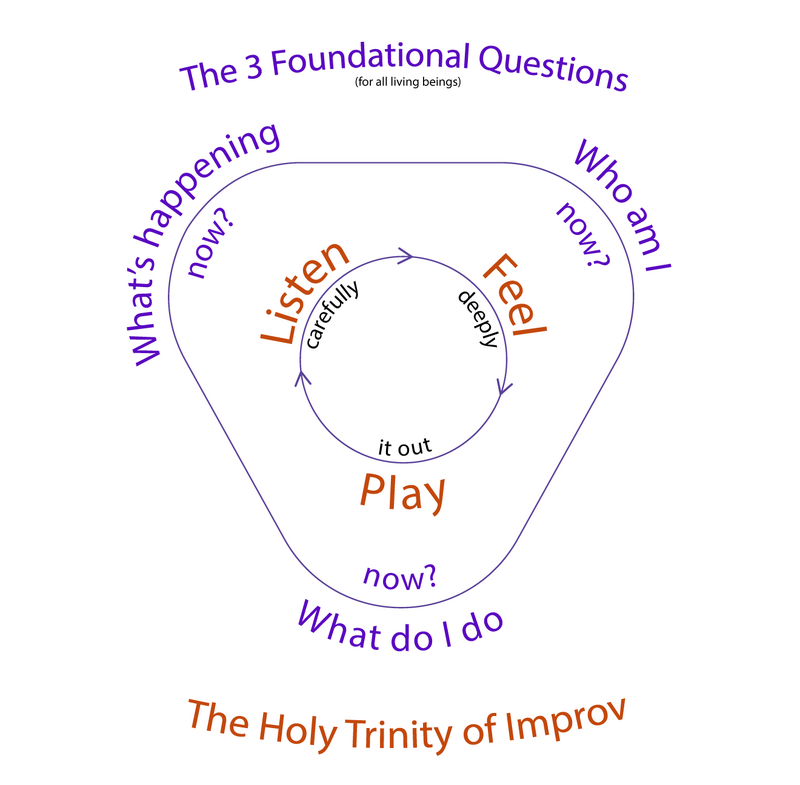
It helps with 1) listening carefully and 2) feeling deeply, but explicitly excludes 3) playing it out.
Without practicing playing when we don't know, we don't develop the tools that can help us navigate unexpected circumstances that show up all the time. It’s a muscle that is as central to being a human being as our heart is.
We are launched into a physical reality that, as far as our finest minds have been able to determine, is grounded in as many questions as answers. There's always more to know, always more to learn.
And while learning is a good thing: it's fun, entertaining, expansive, enriching... I propose that most of the deeper problems we are facing, individually and collectively, do not emerge from our lack of knowledge. They come from our trepidation about moving forward in the direction we most want to go.
We know enough to address the climate crisis responsibly, and we have many tools at our disposal.
We know enough about the experience of living with people who see things differently to know that relationship is not about agreeing on everything before we engage.
There are always questions and there is always unknown. We don't have to be afraid of that. I think the possibility, perhaps even the call, is to learn to love it.
Like the 3 wise men in the ancient story who are told in a dream to go “by another way.”
This song by James Taylor feels like a companion to this work. Its gentle openness, its invitation to listen and trust... It would be a great theme song for what I want to offer through Tune U on Piano. I recorded my own version of it as an nod to conversation with the unknown.
What this song and this practice offer is that we don’t need to know everything in order to proceed. A potent way to begin is to listen more carefully. If you’re curious about tuning into that kind of trust, 15 minutes with this free guided practice into deep listening can be surprisingly helpful.
And if you want the bigger picture of what this practice is and why it works, that lives here: My Philosophy.
I hope this leaves you feeling a little more hopeful about the prospects of having a different kind of experience of yourself and your prospects for living your dreams going forward.
Blessings onward.

When something's off
and you can't tap the flow,
Play your feelings out with sound.
Tune yourself in time.
Play your way home.


Comments