

In just under a week we will be at the autumn equinox, halfway to the winter solstice from the summer one. In the Northern Hemisphere days are getting shorter and the fire of summer is succumbing to water that flows relentlessly toward the center of Earth. Fall is a time of separating the wheat from the chaff, releasing whatever won't help us through the times ahead and digesting the physical, emotional, and spiritual nourishment we've been given that will.
Years ago I had the opportunity to write a song for a public performance of a Community Choreography project that Barrie Barton produced in Asheville for many years. I danced and performed at many of them over the years and it was always surprising and stimulating and fun to see what a bunch of people who don't consider themselves dancers or performers could create when given the space and permission to do so.
One year the theme of the show was "Legacy" and I wrote a song for it called Love Light the Way. I wanted to write something to acknowledge and honor the deeply mixed relationship with my father, Quentin Ervin Barber.
Virtually all the songs I've written (100? 150?) were finished in a few hours to a few days. But I wrote Love Light the Way slowly, day by day, over a period of several months. It needed to take its time. The ideas I thought were going to be the hook and the storyline shifted. When I hit a roadblock I simply stopped and waited a day or two before continuing. Where I normally would have pushed through and forced in more lines, I would simply stop writing and let more time pass.
While Dad was the initial inspiration, others in his family found their way into the song and others in his own ancestral line did as well.
|
We stand upon an ocean |
You can listen to Love Light the Way (along with the whole Marsupial Road Trip album) here if you like.
As we drift toward All Hallows Eve (Halloween) and the Day of the Dead, I am reminded about Dad and what I received from his father's and his mother's family lines.
We've received more from the people we come from than we could ever fathom. Not just the temper and the worry, which is what we often notice. The way we laugh. What our hands do when we're nervous. The fact that we're here at all, breathing, which took an unbroken line of people staying alive long enough to pass it on. As the song says, it's a legacy of mystery hidden right beneath our eyes.
I think that's worth taking some time out to acknowledge, if not all the time, at least occasionally.
We do not "come into" this world; we come out of it, as leaves from a tree. As the ocean "waves," the universe "peoples."
Alan Watts
On the weekend of Halloween I will be doing a retreat where 15 of us will gather and take that time. We will come with drums and percussion and piano keyboards, and any other instruments you might bring. We will also sing and chant and vocalize and make a sound that helps us get beneath the words and closer to the truth.
What gets in the way of accessing that creative, masterful flow state isn't knowledge, or technical ability, or something we think of as performance-worthiness.
It's timing.
In this practice that just means how long you stay with something before you move. Too often, we play something unmistakably noticeable first, decide that's the story, and we bounce. But just like we don't know what we don't know, we don't hear what we give up on too soon. We miss out on what might be there if we take just a little more time with what's actually happening right now. Other things are in there that don't immediately jump out, but offer themselves more subtly.
I watch this at the piano with my clients' improvisations, and I do it myself. An unexpected note happens and we move anxiously on to the next one before it's had a chance to offer its gift. Fixing it before it ends. That looks like high standards. It isn't. It's leaving before the thing finishes, and it's the same leaving we do with the people we come from.
Sound improv is how I go exploring, because sound doesn't ask me to analyze what I found before I've finished finding it. That's most of what Tune U is for.
|
My daughter came into the room and gave me a hug. I asked why and she said she heard me playing and thought it was my wife. When she saw it was me, she was moved to give me a hug. Vic Garlock (after one Playing the Fields session) |
|
Try this. Pick one person you come from. Not the complicated one. The one who was fun. Sit down at whatever is in the house, a piano, a drum, a pot, your own voice, and play something like that person is in the room with you. Imagine them finding your playing fun and coming up with a playful response. Let each sound finish before you make the next one. Ten minutes. No course, nothing to buy, nothing to prepare, and it doesn't have to be good. It works the same whether you've been at this for years or have never done this before. |
What came out that you wouldn't have normally played?
Whatever else this week asks of you, ten minutes of that is available, and the people you come from aren't going anywhere. Enjoy!
Warmly, Daniel
At the end of October
Sounding Through the Veil
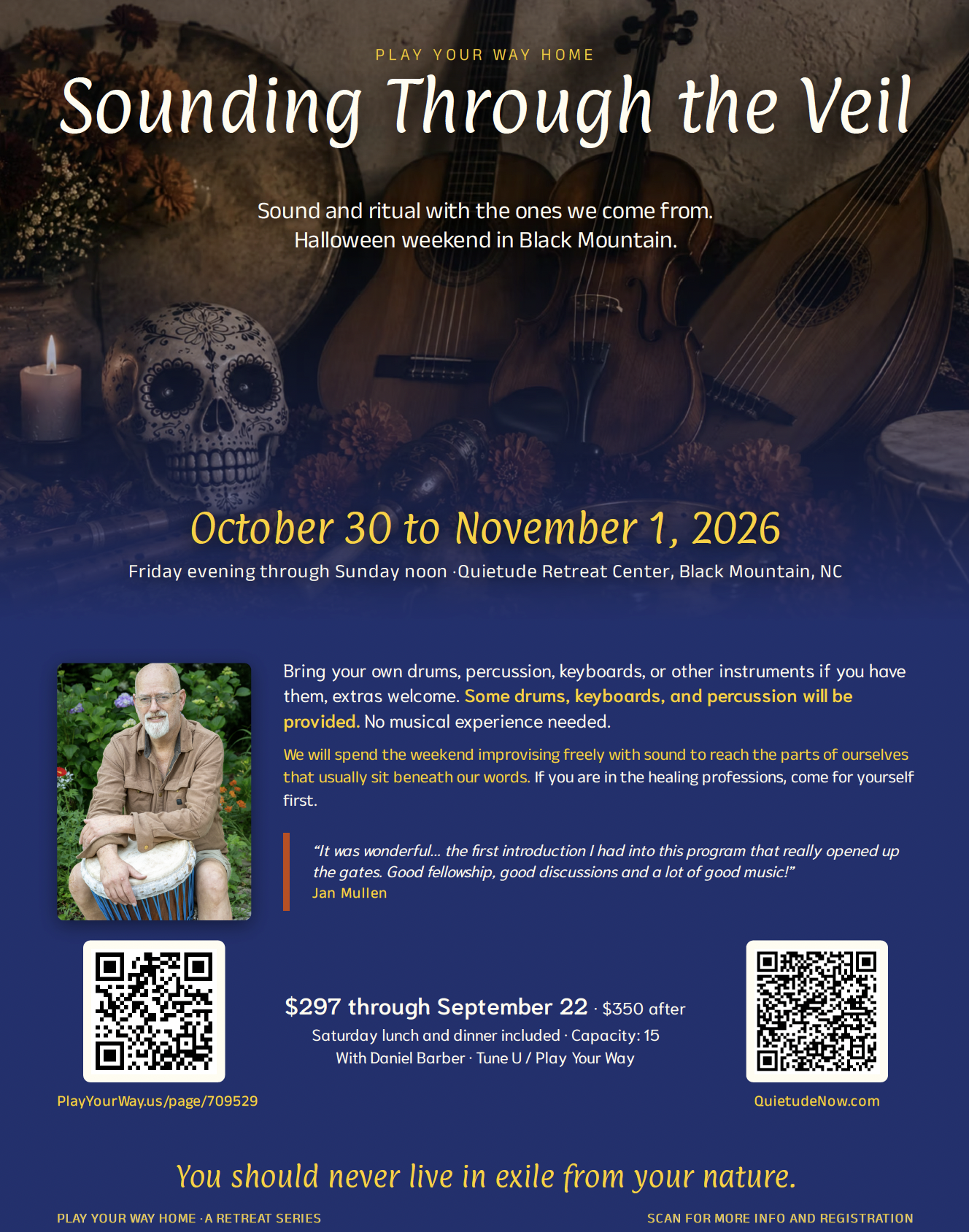
Sound and ritual with the ones we come from. Halloween weekend, Friday evening October 30 through Sunday noon November 1, at Quietude Retreat Center in Black Mountain. Fifteen people. Drums, keyboards and voices, no musical experience needed. $297 through September 22, the equinox, then $350.
On the channel this week
Your Perfectionism Isn't a High Standard. It's a Note You Never Let Finish.
About twelve minutes. The piano version of what's above, with the drum in the room too. The free listening practice is linked under the video.
Ways in
Begin with Listening
A free fifteen-minute guided practice in listening. No instrument, no experience, nothing to get right.
Playing the Fields
One hour at the piano that turns the keyboard from a grid of separate decisions into one connected landscape you can play. Self-paced, $47.
Sounding What's Present
One guided hour at the drum, where the simplicity leaves timing, impulse and restraint in plain view. Self-paced, $47.
From the archive
In the spring of 2020 I hosted a summit called Your Music, Your Way, about thirty conversations on the value of learning to navigate the unknown with sound improvisation. They've been sitting in the back of my channel ever since, most of them unlisted. I'm opening them up now, three at a time, starting with three people who've shaped this work in different ways.
Matthew Fox
I studied for several years at his University of Creation Spirituality. He says most of us don't create because we're afraid to go to the edge, and that traditional schools trained that into us by draining the joy out of learning. He calls the drum the heartbeat of the universe. Rhythm brings us back down into our bodies and onto the ground. He talks in this conversation about silence, the space between the notes, and what happens when we sit there. We stop projecting long enough to actually hear somebody. It's a potent exploration of the potential of sound improv from a transformational theologian. 39 minutes.
Kedar Brown
Kedar is a friend and integrator of indigenous traditional wisdom and ritual I've worked with extensively since 2002. In this interview, he talks about songs as road maps, the way a song line runs across a landscape and walks you along it. Memory isn't only behind you, he says. You can remember something in front of you, a life you haven't lived yet. And what makes you ready isn't knowing. It's open palms and letting "I don't know" be the door. His own song came as a violin and a mandolin out of nowhere, three days into a quest, when he thought he was 50 miles from anyone. 52 minutes.
Jerry Donoghue
Jerry is one of my oldest friends in Asheville, and there are many years of drums and ritual between us. His potent Inner Presence method has been transformational for me and no telling how many others over the years. He helps people engage in compassionate conversations with the various parts of ourselves. In the process, we can come to appreciate the needs of these different parts, and create new and more adaptive strategies for addressing those needs and engaging more creatively with ourselves in all our complexity. This idea has helped clarify some of the core aspects of my Tune U practice. 63 minutes.
P.S. Whether you work with me or not, what matters most is that you keep bringing what you think, feel, say and do into alignment, in real time. That coherence reaches further than either of us can measure. If you are ready, there are clear ways to begin here. If not, I hope you find a practice that serves you.


Comments